


How St Luke’s Catholic College equipped 296 students with the knowledge and confidence to make healthier choices
At St Luke’s Catholic College, wellbeing isn’t a single subject, it’s a culture that underpins every classroom, every conversation, and every learning moment.
Located in the fast-growing north-west corridor of Sydney, St Luke’s has built a reputation for innovation, inclusion, and proactive student support. In 2025, the college took another important step in protecting student health and safety by delivering the OurFutures Vaping Prevention Program to 296 students during Term 2.
For St Luke’s, this wasn’t just about compliance or curriculum alignment. It was about equipping young people with the skills and confidence to make healthy decisions for life.

Chris Bettiol – Leader of Wellbeing, Growth and Development, St Luke’s Catholic College
“The programs aligned perfectly with our school’s wellbeing priorities, which is to enhance the wellbeing and safety of our students,”
— Chris Bettiol, Leader of Wellbeing, Growth and Development, St Luke’s Catholic College
Understanding the Challenge
Vaping continues to be one of the fastest-growing challenges facing Australian schools. According to recent national data, more than one in four high-school students have tried vaping, often unaware of the potential harms or the addictive nature of nicotine.
For teachers, the issue has become more than just a disciplinary concern, it’s a wellbeing one. Educators are increasingly called on to help students navigate misinformation, social pressure, and online marketing targeted directly at teens.
When St Luke’s reviewed its wellbeing framework in early 2025, the leadership team recognised that vaping prevention needed a stronger evidence-based foundation. Rather than develop new resources from scratch, they sought a proven solution that could integrate seamlessly into their existing wellbeing and health curriculum.
Why St Luke’s Chose the OurFutures Program
The OurFutures Vaping Prevention Program is the result of more than a decade of public-health research at the University of Sydney. Trialled with over 5,000 students across 40 schools, the program has been clinically proven to make a lasting impact, students who complete the program are 65 percent less likely to vape 12 months later compared to those who receive standard health education.
The lessons are digital, interactive, and designed with students, for students. Teachers simply register their school, receive onboarding support, and gain access to a ready-to-use teacher dashboard. From there, the modules can be delivered flexibly in classrooms using tablets, computers, or printed materials.
That’s where OurFutures came in.
For St Luke’s, the simplicity and structure were a perfect fit.

Josh Jenkins, Teacher, St Luke’s Catholic College
“It was very easy to run the programs and the kids engaged and benefited from it. Go for it – you won’t regret it,”
— Josh Jenkins, Teacher, St Luke’s Catholic College
Implementation Made Simple
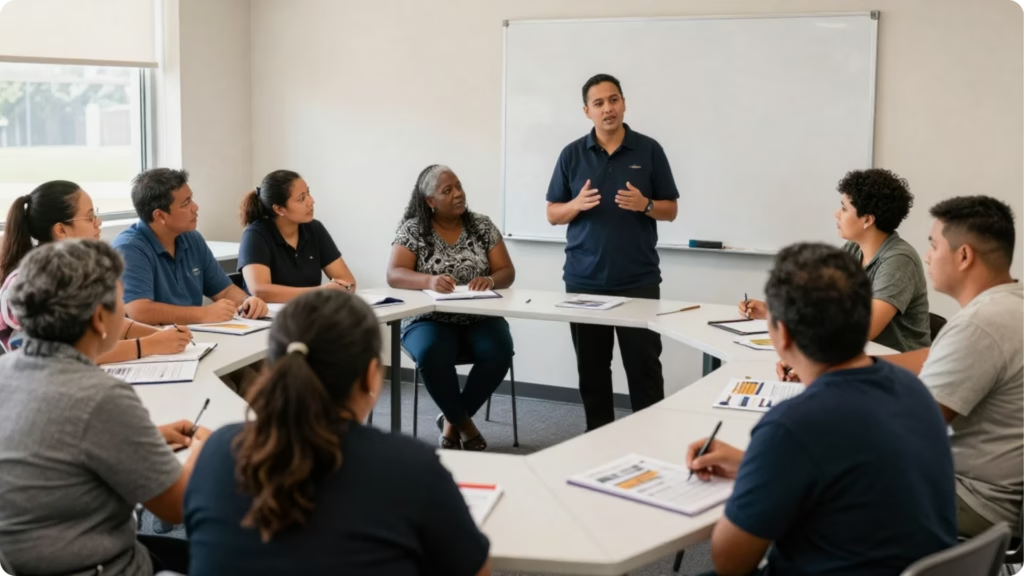
During Term 2, 2025, St Luke’s rolled out the vaping prevention program across Year 7 and 8 classes as part of their health and wellbeing curriculum. Each lesson combined short interactive modules with real-life scenarios, animated comics, and reflection questions that encouraged students to think critically about peer influence and decision-making.
Teachers appreciated that the content wasn’t fear-based or moralising. Instead, it used evidence, empathy, and relatable storytelling to help students understand the social and health consequences of vaping.
“Because the program was online and self-paced, it allowed us to deliver it within existing class time without adding extra workload,” said Mr Jenkins. “The students actually looked forward to the sessions — they’d ask what happened next in the story.”

Josh Jenkins, teaching students at St Luke’s Catholic College
The OurFutures platform also provided teachers with discussion prompts and summary questions to extend conversations beyond the screen. This gave educators confidence to facilitate deeper discussions about health choices, advertising tactics, and resilience.
Student Perspectives: Awareness That Lasts
For students at St Luke’s, the program offered a refreshing change from traditional health lessons. Rather than being lectured, they were immersed in animated stories that mirrored their own experiences — friends hanging out after school, navigating peer pressure, or seeing someone vape for the first time.
“I really liked the comics in the program because they were animated and lively,” said Alexia, a Year 8 student. “They made the information about vaping easy to understand.”

Year 8 students at St Luke’s Catholic College
Another student reflected on how relatable the scenarios felt:
“I liked how it was told from a teenager’s perspective, just like us. It showed how we might experience the same situations in real life.”
Students said the program gave them tools to think critically, not just warnings to avoid risk.
“It helped me understand how to make proper decisions,” Alexia continued. “It broke things down and asked us questions along the way about what vaping is and how it could affect us. Now I feel more confident about what to do if I’m ever offered one.”

Year 8 students at St Luke’s Catholic College
For teachers and wellbeing leaders, those reflections were powerful. They showed not just awareness but agency; students developing the capacity to make and defend their own healthy choices.
Evidence That Speaks for Itself
The OurFutures Vaping Prevention Program is unique because it doesn’t rely on scare tactics or untested messaging. Every lesson is grounded in decades of behavioural-science research from The Matilda Centre for Research in Mental Health and Substance Use at the University of Sydney.
Independent peer-reviewed studies, including one published in The Lancet Public Health (2025) – demonstrated that students who completed the program were 65 percent less likely to vape 12 months later, with benefits extending to improved mental wellbeing and healthier attitudes toward substance use overall.
For schools like St Luke’s, this evidence was the deciding factor.
“We wanted a program that wasn’t just engaging but proven to work,” explained Mr Bettiol. “Our students’ wellbeing and safety are paramount, and this gave us confidence that what we were teaching would have a real impact.”
A Model for Other Schools
The success of St Luke’s Catholic College shows what’s possible when evidence, engagement, and ease of delivery align. The school’s commitment to prevention has already sparked interest among other schools in the Diocese, with teachers sharing feedback about how straightforward implementation was and how positively students responded.
Mr Jenkins believes the program’s accessibility was key to its success. “Everything you need is there — lesson plans, videos, assessments — it’s all ready to go. For busy teachers, that’s a huge help. It saves time and makes a difficult topic easy to approach.”
The school now plans to continue incorporating OurFutures modules across its broader wellbeing framework, integrating topics such as alcohol, drugs, and mental health into future terms.
National Context: Prevention That Works
Across Australia, schools are looking for ways to respond to the rising tide of vaping. From policy restrictions to on-campus detection systems, the conversation often focuses on control. But educators like those at St Luke’s are proving that prevention and education can be even more powerful.
By embedding evidence-based education early — before experimentation begins — schools can shift culture, strengthen decision-making skills, and build long-term resilience in students.
And because the program is fully funded by the Australian Government, there are no costs to schools, making it accessible to every public, independent, and Catholic secondary school nationwide.
“There’s really no downside,” said Mr Jenkins. “It’s easy to use, backed by research, and completely free. For us, it just made sense.”
Watch Their Story
The Bigger Picture
Programs like OurFutures demonstrate how evidence-based education can drive real behaviour change. By giving teachers practical tools and students relatable learning experiences, schools can create environments where prevention becomes part of the everyday language of wellbeing.
For St Luke’s Catholic College, that means knowing their students aren’t just informed – they’re empowered.
“We see wellbeing as the foundation of learning,” said Mr Bettiol. “When students feel safe, supported, and equipped with knowledge, everything else, academic growth, confidence, community, flows from there.”
Get Involved
If your school is ready to strengthen its wellbeing and student-safety strategy, join the hundreds of schools already making prevention part of their curriculum.
Register your school today and deliver evidence-based prevention that works.
Proudly supported by